Tumba Francesa
Tumba Francesa
Tumba Francesa is an artistic tradition little known to the general public, yet extraordinarily rich. Blending African heritage, Haitian influences, and European dance forms, it embodies a vital dimension of eastern Cuba's cultural identity. At the crossroads of rhythms, languages, and memories, it perpetuates a history of resistance, creativity, and transmission.
Tumba Francesa is an artistic tradition little known to the general public, yet extraordinarily rich. Blending African heritage, Haitian influences, and European dance forms, it embodies a vital dimension of eastern Cuba's cultural identity. At the crossroads of rhythms, languages, and memories, it perpetuates a history of resistance, creativity, and transmission.
History
Tumba Francesa, literally "French drum," stands as one of Cuba's oldest expressions of music and dance. Its roots trace back to the late 18th century, when roughly 30,000 French colonists fled the Haitian Revolution of 1791. They arrived in eastern Cuba, primarily in Santiago de Cuba, Guantánamo, and Holguín, as well as in the island's central regions (Matanzas, Cienfuegos), accompanied by their African enslaved workers, many originally from Dahomey.
These enslaved individuals, often household staff familiar with European ball dances, brought with them their rituals, songs, and drums. As these traditions merged with French customs—particularly contredanses, rigodons, and minuets—and the Haitian Creole language of Saint-Domingue, a hybrid artistic form emerged: Tumba Francesa.
Following the abolition of slavery in Cuba in 1886, many freed people settled in towns and established Tumba Francesa societies, similar to African cabildos (mutual aid community structures). These societies flourished in the late 19th century. Three survive today, the oldest being the Lafayette Society, founded in 1862 in tribute to the French general.
Heritage and Cultural Significance
Tumba Francesa embodies the fusion of:
- Music from Dahomey
- French ball dances
- Saint-Domingue Creole language
- Cuban social realities.
Although its name evokes France and its origins Haiti, Tumba Francesa is today an authentic symbol of Afro-Cuban culture, a living bridge spanning three continents—Africa, Europe, and the Americas.
Early performances took place in coffee-drying facilities transformed into ephemeral stages. Here, a "king" and "queen" were symbolically elected, while a "caneman" or "mayor de plaza" directed the dances.
A Codified Spectacle of Song, Dance, and Percussion
A Collective Performance
Each Tumba Francesa presentation is a collective work bringing together:
- Musicians playing drums and idiophones
- Singers, led by a soloist called composé
- Dancers, men and women elegantly costumed.
Performances follow a codified structure, alternating improvised moments with ritualized sequences. They can last the entire night, chaining together songs and dances of roughly 30 minutes each.
Traditional Instruments
Musicians use exclusively percussion instruments, all inherited from African traditions:
- Catá: large wooden idiophone struck with bare hands, it establishes the rhythm.
- Tumbas: three drums (mamier, segón, bulá) carved from a single hollowed trunk, adorned with carved and painted motifs.
- Tambora: two-headed drum used in the toque masón.
- Chachás, marugas, sonajas: metal rattles decorated with ribbons, shaken by the singers.
Together they form an ensemble with a repetitive, infectious rhythmic quality conducive to dance.
Song: Between Memory and Identity
Singing is performed in Haitian Creole, Spanish, or French patois. The composé opens with a solo, answered by a chorus of singers called tumberas. Themes vary: daily life, resistance, spirituality, or social commentary. The vocal form follows the call-and-response structure typical of Afro-diasporic music.
The Dances of Tumba Francesa
El Masón
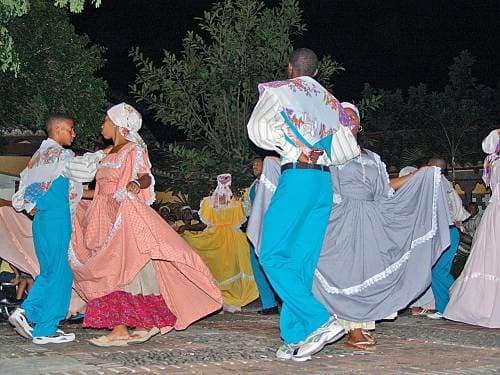
An opening dance, masón is a codified parody of French salon dances. Couples execute elegant figures—quadrilles, arches, carousels, rounds—gliding across the floor without lifting their feet. Each sequence is directed by a whistle from the mayor de plaza.
Here are some emblematic figures:
- Carabiné
- Baile del pañuelo (handkerchief dance)
- Cinta (dance around a maypole with woven ribbons).
El Yubá
Freer and more rhythmically driven, yubá showcases spontaneity and African heritage. Dancers, in couples or solo, move within a circle. The rhythm intensifies through the drums, and steps become faster.
El Frenté
Considered the pinnacle of yubá, frenté is an acrobatic male dance built on a duel between the dancer and the principal drummer. The improvising soloist is honored by spectators tying scarves around his body.
A Striking Aesthetic in Costume
Costumes form an integral part of the performance:
- Women wear long colonial dresses with ruffles, silk scarves (fulá or madrás), necklaces, shawls, and chachás.
- Men are dressed in frock coats, white shirts, and French-style trousers.
These garments reinforce the cultural duality of the tradition, between European elegance and African symbolic power.
A Rare yet Living Tradition
Tumba Francesa remains a living but little-documented Afro-Cuban tradition, transmitted primarily through oral tradition and collective performance. Despite its cultural and musical richness, few recordings testify to it. Among the rare existing archives is Volume VII of the Anthology of Afro-Cuban Music, realized in 1976 by Danilo Orozco. This recording presents several versions of the toques masón and yubá, true rhythmic pillars of this music.
Other recordings, notably produced by the Soul Jazz Records label, have helped preserve the sonic memory of this hybrid art. These documents remain essential for understanding the percussive complexity and symbolic dimension of Tumba Francesa.
Today, this tradition continues in the working-class neighborhoods of eastern Cuba, particularly during carnivals and community celebrations. Carried forward by descendants of Haitian enslaved people, Tumba Francesa embodies the pride of an Afro-Haitian heritage deeply rooted in Cuban identity.
Tumba Francesa Societies Today
While hundreds of Tumba Francesa societies existed in the 19th century, only three have survived to the present day, zealously preserving this cultural tradition. These societies are far more than artistic ensembles: they play a fundamental community role, transmitting songs, dances, toques, and historical narratives from generation to generation.
Here are the three still-active societies today:
- La Caridad de Oriente, founded in 1862 in Santiago de Cuba (formerly called Lafayette), is the most emblematic.
- Santa Catalina de Riccis, also known as La Pompadour, is based in Guantánamo.
- Bejuco, located in the rural municipality of Sagua de Tánamo in Holguín province, remains more discreet yet no less precious.
These Tumba Francesa societies trace their origins to the old coffee plantations established by French colonists between the late 18th and early 19th centuries. Even today, their members often bear names of French origin and remain dedicated to keeping this centuries-old tradition alive, at times adapting toques to modern stage forms while never compromising authenticity.
Heritage Recognition
In 2003, Tumba Francesa La Caridad de Oriente was proclaimed a Masterpiece of the Oral and Intangible Heritage of Humanity by UNESCO. It was subsequently officially inscribed on the Representative List of the Intangible Cultural Heritage of Humanity in 2008. These distinctions highlight the historical, identity, and artistic value of this Afro-Cuban tradition.
Tumba Francesa also received the National Prize for Community Cultural Heritage in Cuba, recognizing its social role and grassroots significance. It now forms part of the "Route of the Slave—Cuba" project, coordinated by the National Council of Cultural Heritage in Havana, which works to preserve and transmit this living heritage.
Where to See a Tumba Francesa Performance?
The best place to witness a performance remains Santiago de Cuba, particularly during the Caribbean Festival or at special ceremonies organized in historic neighborhoods.
Museums such as the Casa de la Tumba Francesa in Santiago also allow visitors to explore this tradition through archives, costumes, instruments, and occasionally live demonstrations.
Give it a go!
Our local experts arrange this activity for you.