Museo Girón
Museo Girón
Located on Cuba's southern coast at the entrance to the Zapata Peninsula, Museo Girón reveals one of the most pivotal episodes of the Cold War in Latin America. Behind its modest walls lies the story of the failed 1961 Bay of Pigs invasion.
Located on Cuba's southern coast at the entrance to the Zapata Peninsula, Museo Girón reveals one of the most pivotal episodes of the Cold War in Latin America. Behind its modest walls lies the story of the failed 1961 Bay of Pigs invasion. Here, history isn't merely read through display cases or photographs—it's felt through the atmosphere of Playa Girón, the theater of 1961's dramatic events. Visiting this museum means immersing yourself in a national narrative where memory, ideology, and resistance intertwine.
Historical Context
Situated at Playa Girón on the southern coast of Matanzas province, Museo Girón chronicles one of the most significant episodes in contemporary Cuban history: the failed Bay of Pigs invasion in April 1961. The museum exists to preserve the memory of a confrontation that profoundly shaped minds both within Cuba and across the globe.
In April 1961, as Cold War tensions divided the world, approximately 1,400 Cuban exiles—trained and supported by the CIA—landed at Playa Girón with the aim of overthrowing Fidel Castro's recently established government, which had taken power following Batista's regime collapse in 1959. This destabilization attempt, orchestrated by the United States and backed militarily, sought to halt the island's communist orientation and its strategic rapprochement with the Soviet Union.
For three days, from April 17 to 19, 1961, fierce fighting raged through the marshes of the Zapata Peninsula. Cuban armed forces mounted fierce resistance. The operation quickly turned catastrophic for the invaders: nearly a hundred were killed, and the majority were captured before later being returned to the United States. Cuban losses numbered over 170 dead and more than 500 wounded.
This humiliating failure became a powerful symbol for the revolutionary regime, which viewed it as the first great defeat of American imperialism in Latin America. Museo Girón, positioned precisely where the confrontation occurred, stands today as a memorial to this national victory. Through its collections, it displays the physical evidence of conflict. As both a place of memory and an ideological platform, this museum illuminates how this military event became a cornerstone of Cuba's revolutionary narrative.
The Exhibitions
The building housing Museo Girón was constructed in late 1959 in a simple style. From 1964 onward, its two rooms hosted a photographic exhibition documenting the Cuban people's response to the mercenary forces hostile to the nascent Revolution. The facility was later expanded and officially became a municipal museum on April 19, 1976, marking the 15th anniversary of the battle. Two years later, it was designated a National Monument through resolution no. 3 on October 10, 1978, in recognition of its historical significance.
The museum honors Cuba's victory during the Playa Girón invasion. It demonstrates how the Revolutionary National Militias, the Liberation Army, the Revolutionary National Police, and the Navy unified their forces to defend the nation. Supported by limited but effective air power, they managed to repel—in just 65 hours—a heavily equipped mercenary force sent by the United States.
The two exhibition halls contain objects related to the April 1961 confrontations:
- Photographs
- Maps
- Weapons
- Uniforms
- Documents
- Personal effects
A 15-minute film, available for an additional 1 CUC, recounts the battle and frames this defeat as the first inflicted on American imperialism in Latin America.
Several emblematic objects are also on display:
- The pilot insignia and ranks of Luis Alfonso Silva Tablada, founder of the Rebel Air Force
- The blood-stained uniform of Eduardo Garcia Delgado, killed in combat after writing "Fidel" in his own blood
- The shoes of Nemesia Rodriguez Montaño, damaged during bombardments that cost her mother's life
- The personal effects of Rolando Valdivia Fernández, an artilleryman from the Granma base
A photographic mural presents portraits of approximately 300 Cuban soldiers killed in combat, accompanied by their names and dates. Personal objects and military equipment accompany them in display cases. Some captions are bilingual.
The museum's role extends beyond exhibitions: it preserves heritage, organizes permanent and temporary exhibitions, disseminates local and national history, and offers cultural activities such as:
- Lectures
- Adult courses
- Children's circles
- Thematic exhibitions
Museo Girón is currently undergoing digitization. Screens enable virtual visits, and QR codes positioned near artifacts provide access to supplementary content.
The Outdoor Space
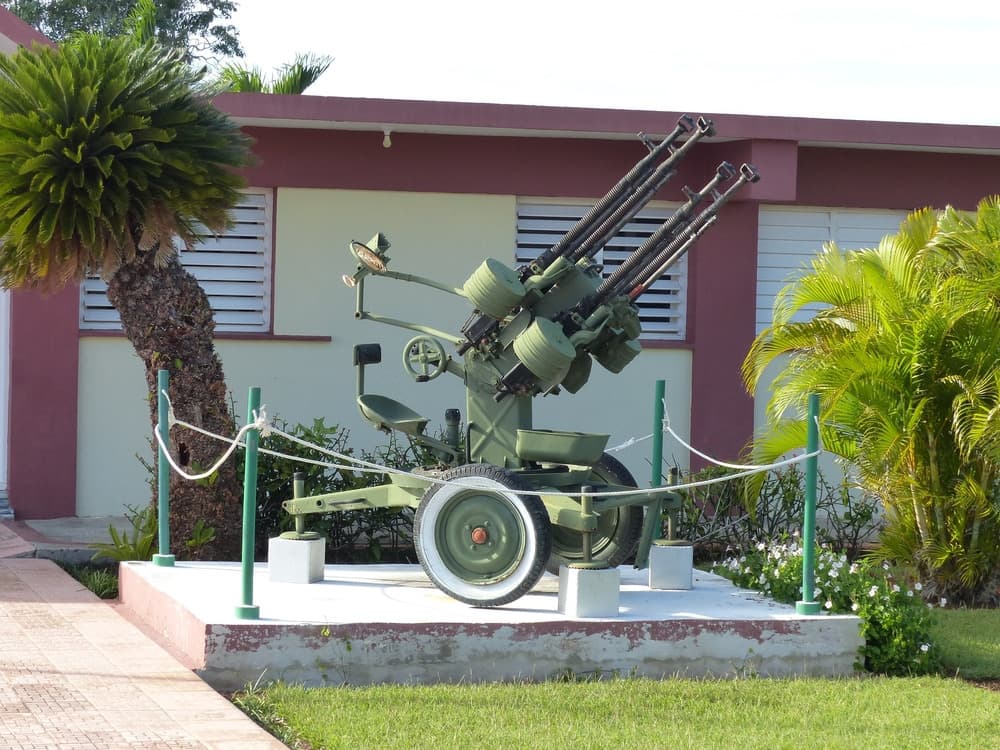
Upon exiting the museum, you enter an open-air space displaying several military remnants directly connected to the April 1961 combat. This outdoor exhibition complements your visit strikingly, providing concrete scale to the material resources mobilized during the invasion.
Among the outdoor displays are items from Brigade 2506, including:
- 81 mm Mod-35 mortars
- Browning M2 machine gun caliber 50
- 75 mm anti-tank gun
- Combat fatigues
- M41 Walker Bulldog tank
- Motorized landing craft
- "Comando" armored truck
- Wreckage of a downed B-26 aircraft
On the Cuban side are Soviet 82 and 120 mm mortars, Czechoslovak heavy machine guns, and a British Hawker Sea Fury fighter aircraft. Alongside these are remains of a downed American aircraft, cannons, heavy weapons, and several boats that participated in operations.
The Playa Girón Museum occupies a long single-story building easily accessible from the beach. From Cienfuegos, the journey takes approximately 1.5 hours by car. You can reach it by automobile, bus, or even hitchhiking, though some road sections may be in poor condition.
Practical Information
The museum is open daily, typically from 8:00 AM to 5:00 PM. Admission costs approximately 2 CUC. Additional fees may apply: 1 CUC for camera use. Most explanatory signage is in Spanish only. There is no English signage, which can complicate visits for non-Spanish speakers. It is therefore strongly recommended to visit with a local guide or an English-speaking companion. Translated brochures may occasionally be available upon request.
Give it a go!
Our local experts arrange this activity for you.