The Complete History of the Cuban Mojito
It's the cocktail beloved across the English-speaking world and one of the most popular globally—the mojito! To understand the scale of this worldwide phenomenon,
It's the cocktail beloved across the English-speaking world and one of the most popular globally—the mojito! To understand the scale of this worldwide phenomenon, we're sharing the story of how this cocktail was born and how it conquered the entire world. Plus our tips for making the authentic Cuban mojito recipe.
The Origins of the Mojito
The origins of this legendary cocktail date back to the 16th century. Legend has it that it appeared thanks to the English corsair and explorer Francis Drake. When he anchored with his crew at Isla de la Juventud, the pirate quickly fell in love with Cuba. Between raids, the man known as 'el draque' enjoyed sipping tafia, a sugarcane spirit infused with mint leaves. The first version of the mojito thus made its appearance.
It wasn't until 1910 that the recipe evolved, giving birth to the mojito as we know it today. The tafia was replaced with rum and lime was added to enhance the flavors. Its name evolved, drawing inspiration from the term 'mojo', belonging to a dialect spoken by enslaved workers in the sugarcane fields. Mojo designated a spell or charm. For others, it simply meant an asseasoning made with lime. In any case, the mojito quickly became a symbol of Cuban culture, so much so that by 1920, it rose to the status of Cuba's national cocktail.
When the Mojito Conquered the World
As we mentioned, the mojito spread widely throughout Cuba during the 1910s and 1920s. Its success allowed it to cross borders a few years later. And this wouldn't have happened without the help of Ernest Hemingway. Indeed, during his time living in Cuba between 1939 and 1960, the American writer and journalist made a habit of sipping a mojito at the Bodeguita del Medio, a legendary bar-restaurant in Havana.
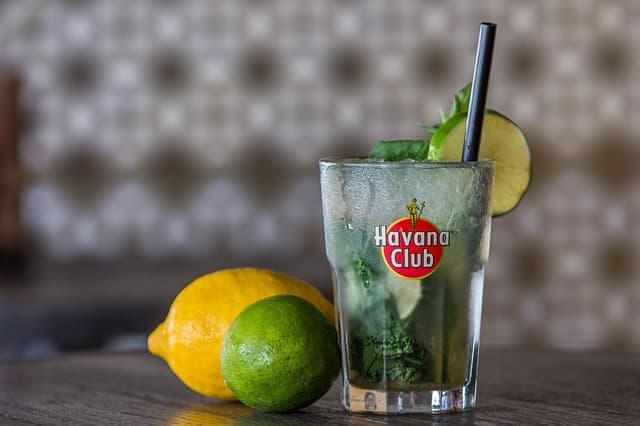
He wrote about it in his literature, and his phrase « my Mojito at La Bodeguita del Medio, my Daiquiri at the El Floridita » greatly contributed to the mojito's success worldwide. The mojito then spread to the United States and then Europe. In France, the cocktail became particularly popular in the 1990s thanks to advertising and marketing campaigns by the rum brand Havana Club! Since then, it's been everywhere in bars and on TV, including in the famous scene from the James Bond film Die Another Day where the sultry Halle Berry shares the legendary mojito with James Bond…
The Authentic Cuban Mojito Recipe
Contrary to what you might think, the true Cuban mojito is made with ice cubes and not crushed ice! Similarly, you don't use brown sugar but rather white sugar! As for the mint leaves, it's especially the stems that should be macerated, as they contain all the essential oils and truly perfume the cocktail!
The Cuban mojito recipe thus requires starting by crushing mint stems and leaves with white sugar (2 teaspoons is enough) at the bottom of the glass. You can then squeeze the juice from a lime wedge, pour in Cuban rum (about 4.5 cl), add ice cubes, pour in sparkling water (about 9 cl) and mix it all together! All that's left is to enjoy your drink and share the famous story of the Cuban mojito with all your friends…
Frequently asked questions
The mojito's origins trace back to the 16th century, linked to the legend of corsair Francis Drake. Its modern recipe with rum and lime appeared around 1910 and it became Cuba's national cocktail by 1920.
The authentic Cuban mojito is made with ice cubes (not crushed ice), white sugar (not brown sugar), and the mint stems rather than leaves alone are macerated, since they concentrate the essential oils.
Hemingway lived in Cuba between 1939 and 1960 and was a regular at La Bodeguita del Medio in Havana. His famous phrase « my Mojito at La Bodeguita del Medio » helped make the cocktail known throughout the world.
Crush mint stems and leaves with 2 teaspoons of white sugar. Add the juice from a lime wedge, 4.5 cl of Cuban rum, ice cubes and 9 cl of sparkling water. Mix and enjoy!
The mojito gained popularity in France during the 1990s, notably thanks to marketing campaigns by the rum brand Havana Club, which heavily promoted it in French bars and media.