Pharmaceutical Museum
Pharmaceutical Museum
In Matanzas, the Museo Farmacéutico preserves in its original state a 1882 pharmacy, Latin America's first pharmaceutical museum, inscribed as a UNESCO Memory of the World in 2025.
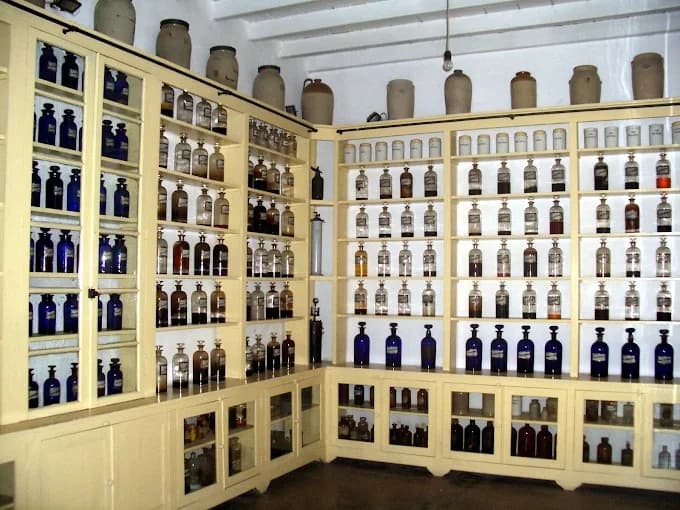
In the heart of Matanzas, nicknamed "the Athens of Cuba," the Museo Farmacéutico preserves in its original state a nineteenth-century pharmacy. Behind its neoclassical façade, cedar shelving, colored glass bottles, handwritten registers and a preparation table that won a prize in Paris in 1900 tell the story of a family pharmacy that operated for 82 years, becoming in 1964 Latin America's first pharmaceutical museum.
Why visit the Pharmaceutical Museum of Matanzas
The site offers three complementary points of interest. First, authentic décor: the furniture, columns, shelves engraved with "Botanica francesa de E. Triolet" and French porcelain jars (albarelos) have remained in place since the pharmacy opened in 1882. Second, a world-class documentary collection, inscribed in April 2025 in the UNESCO Memory of the World register (Latin America and the Caribbean) for its prescription records. Finally, a concrete immersion into nineteenth-century pharmacology, with over 150 types of remedies prepared on the premises.
The museum has been designated a National Monument since 2007 (Protection Grade I) and received the National Restoration Prize in 2008. Plan on 1 to 1.5 hours for a visit, longer with a detailed guided tour.
History of the Botica Francesa
A French foundation in Matanzas
The story begins in January 1882, when French pharmacist Ernesto (Enrique) Triolet Lefevre, originally from Lissy, and his Cuban partner Juan Fermin de Figueroa found a modern pharmacy facing the old Plaza de Armas (today Parque de la Libertad), on calle Milanés. The building, designed specifically to house a pharmacy, exemplifies the neoclassical domestic architecture of the late nineteenth century: dressed stone, central courtyard, commercial ground floor and residential upper floor.
A flagship pharmacy for 82 years
The Botica Francesa quickly became a Cuban institution, delivering elixirs, syrups, salves and tinctures to homes. Leadership remained family-run: Dolores Figueroa, Triolet's wife and Cuba's first female doctorate-holder in pharmacy, took over, followed by their nephew Ernesto Valdés Figueroa, and finally Ernesto Luis Triolet Figueroa (born 1893, doctorate in pharmacy 1914), who continued until nationalization. All prescriptions were recorded in ferrogallic ink (made from gall nuts and iron), ensuring that over 500,000 pharmaceutical formulas remain legible to this day.
From laboratory to museum
The pharmacy was nationalized on January 16, 1964. A few months later, on May 1, 1964, it reopened as Latin America's first pharmaceutical museum, under the direction of historian Israel Moliner Rendón and plastics director Pedro Esquerré. Ernesto Luis Triolet, the last owner, became the first curator and continued to live on the upper floor. From 2003 onward, extensive restoration work was undertaken on the columns, murals, furniture and bottles, respecting the original décor.
What to see in the museum
The main room and the back pharmacy
The showroom retains its counter, cedar shelving and rows of hand-painted jars still bearing the names of old ingredients: hops, star anise, belladonna root, triaca magna, copal. Colored glass bottles, manufactured in the United States, complete an ensemble of remarkable coherence.
The prize-winning preparation table
The centerpiece of the laboratory is the medicine preparation table, designed by Triolet in yellow jocuma, a Cuban hardwood. Measuring 5.51 meters long with 32 drawers and accompanied by scales, marble mortars, suppository molds and pill jars, it won a prize at the Paris Universal Exposition in 1900.
Homemade remedies
Over 150 preparations were produced on site. Among the most emblematic: coffee syrup compounded against asthma and bronchitis, scorpion oil, tranquilizing balm, benzoin tincture and dewberry honey cream. Some recipes developed by Triolet are still passed down orally today.
The documentary collection
The museum preserves 55 handwritten registers totaling approximately 1.5 million pharmaceutical formulas drawn from Spanish, French, North American and Cuban pharmacopeias. Now digitized, these documents continue to be consulted by students and researchers. It was this collection that justified inscription in the UNESCO Memory of the World register in April 2025. The entire museum collection exceeds 5 million objects: instruments, jars, labels, books and furniture.
The night lantern
Hung on the façade since 1882, the night lantern is lit each Monday evening to signal the nighttime service, as it was in the days of the Botica Francesa.
Practical information
The museum is located on calle Milanés, at the edge of Parque de la Libertad, in Matanzas' historic center. It is open daily, generally in the morning and early afternoon, with reduced hours on Sunday: verify opening hours on the day of your visit, as they vary by season. The admission rate remains modest for foreign visitors; a small surcharge applies for photography and for the guided tour, which adds considerable value given the density of objects on display.
How to get there
Matanzas is located approximately 100 km east of Havana and 35 km west of Varadero. Several options are available:
- From Havana: Viazul bus (approximately 3 hours), shared taxi or rental car via the Via Blanca highway.
- From Varadero: taxi, organized tour or local bus (45 minutes to 1 hour).
- Hershey Train: historic line between Casablanca (Havana) and Matanzas, slow but picturesque, worth taking for the journey itself.
The museum is then just a few minutes' walk from the center, in the heart of the old town.
What to combine in the region
Matanzas lends itself well to a day of cultural exploration. Near the museum, Parque de la Libertad, the Sauto Theater and the cathedral are worth a visit. To extend your trip to Cuba, several sites complement the visit nicely:
- The Bay of Pigs, 2.5 hours to the south, for its history and marine life.
- The Caguanes National Park, in the neighboring province of Sancti Spíritus.
- The Jagua Castle, near Cienfuegos, for its eighteenth-century military architecture.
Frequently asked questions
Frequently asked questions
Plan your trip
The pharmaceutical museum fits naturally into a Cuban cultural itinerary combining Havana, Matanzas, Cienfuegos and Trinidad. To design a custom trip, consult our journeys to Cuba and their heritage highlights.
Interested in this visit?
We can include it in your personalised itinerary.