Plaza de la Revolución in Havana: Guide & Must-See Information
Plaza de la Revolución in Havana: Guide & Must-See Information
An emblematic plaza in Havana, Plaza de la Revolución brings together the José Martí Memorial and towering portraits of Che and Camilo Cienfuegos.
Plaza de la Revolución is among the world's largest urban squares, spanning 72,000 m² laid out on the Loma de los Catalanes at 142 meters above sea level. At the heart of Vedado district in Havana, it unites around a rectangular esplanade the José Martí Memorial, the Palace of the Revolution, and several government buildings adorned with monumental portraits of Che and Camilo Cienfuegos. Both an administrative center and place of memory, it remains the stage for Cuba's major political gatherings.
Why Visit Plaza de la Revolución
Less picturesque than Plaza Vieja or Plaza de la Catedral, Plaza de la Revolución distinguishes itself through its role in the nation's political life. It was here that Fidel Castro delivered some of his longest speeches to crowds exceeding one million people, where popes John Paul II in 1998 and Francis in 2015 celebrated Mass, and where Fidel Castro's official funeral was held in 2016.
The plaza also lends its name to one of Havana's 15 municipalities, extending from the Malecón to the Vedado district. For understanding Cuban revolutionary iconography and the staging of power, few places speak as eloquently.
History of the Plaza
The concept of a grand central plaza dates to the 1920s, when French urban planner Jean-Claude Nicolas Forestier designed a modern urban plan for Havana, inspired by Paris's Place de l'Étoile. The project envisioned an esplanade at the summit of Loma de los Catalanes, a convergence point for avenues radiating toward the Almendares River, Centro Habana, the Park of Fraternity, and Vedado.
Construction did not begin until the 1950s, under Fulgencio Batista's dictatorship. The plaza, then named Plaza Cívica, was conceived as a civic center surrounded by public buildings: library, ministries, national theater.
In 1959, following Batista's overthrow, Fidel Castro renamed it Plaza de la Revolución. The site became a landmark for popular assembly and political mobilization, hosting annual May 1st celebrations and anniversaries of the Revolution.
What to See on the Plaza
The José Martí Memorial
At the plaza's center, the José Martí Memorial honors Cuba's 19th-century national hero. It takes the form of a truncated pyramidal tower 112 meters tall, built in light gray marble from the Isle of Youth, reaching 142 meters when including beacons and flags atop. No building in Havana is permitted to surpass it.
At its base sits a monumental statue of Martí, seated and contemplative, created by sculptor Juan José Sicre between 1956 and 1958. It measures 18 meters and was assembled from 52 blocks of white marble, the head carved from a single 18-ton block. Six pillars surround the work, referencing Cuba's former provinces.
The project, initiated in 1938, began in 1953 under Batista, after demolition of the former Catalan chapel. The site was inaugurated in 1958, then transformed into a memorial in 1996, marking the centenary of Martí's death.
The Museum and Viewpoint
The star-shaped base houses a museum spread across its five wings: personal items, photographs, documents on the monument's construction and Martí's life. The galleries are decorated with golden glass mosaics from Venice.
A 90-meter elevator and staircase of 579 steps lead to a viewpoint at 129 meters, offering panoramic views of Havana and surroundings on clear days. A compass rose indicates distances to 43 world capitals, Cuba's six former provinces, and Dos Rios, where Martí fell in 1895.
Portraits of Che and Camilo Cienfuegos
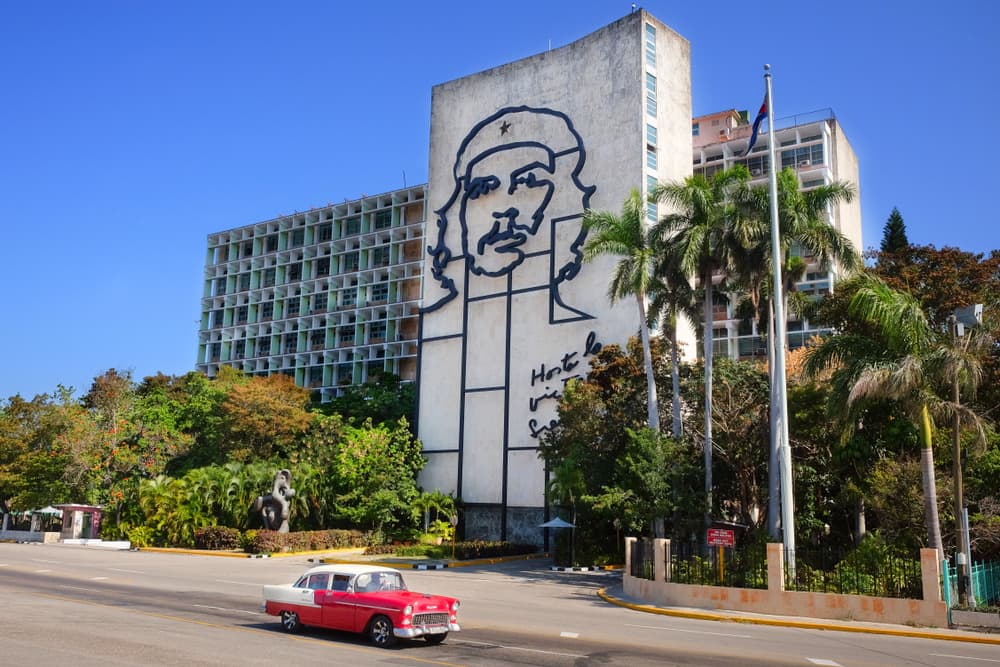
On the facade of the Ministry of Interior, northwest of the plaza, a giant steel portrait of Ernesto Che Guevara was created by artist Enrique Ávila based on Alberto Korda's 1960 photograph. Below the guerrilla fighter's face reads the motto "Hasta la victoria siempre." Illuminated at night, it is among Cuba's most photographed images.
On the neighboring Ministry of Telecommunications, a twin sculpture depicts Camilo Cienfuegos, Castro's comrade-in-arms. Added in 2009, it carries the inscription "Vas bien, Fidel" ("You're on the right course, Fidel").
Official Buildings
- The Palace of the Revolution, seat of government and the Cuban Communist Party
- The José Martí National Library, east of the plaza
- The National Theater of Cuba, inaugurated in 1979
- The Ministry of Armed Forces
Practical Information
The esplanade, bounded by Aranguren, Paseo, Céspedes, and Independence avenues, is freely accessible throughout the day. The José Martí Memorial and its museum are open daytime hours; check hours before visiting, as they may vary on official ceremony days.
Museum entry and viewpoint access are paid at a modest rate for foreign visitors, with an additional fee for photography inside. Allow 1 to 1.5 hours to walk the plaza and visit the memorial. Early morning hours are preferable: light is softer on the pale marble and buildings, and heat remains manageable on this highly exposed esplanade.
How to Get There
The plaza sits in Vedado district, approximately 10 to 15 minutes by taxi from Old Havana's historic center. Most visitors arrive as part of a classic American convertible car tour, which includes a photo stop before the Che and Camilo portraits. Shared taxis (almendrones) circulating on Paseo and Independence Avenue also approach nearby. On foot, allow roughly thirty minutes from the Malecón, ascending steadily toward Loma de los Catalanes.
Nearby Attractions
The plaza fits into a broader itinerary through the capital and island. To extend your visit, explore Vedado district and the Malecón from Havana, or plan additional cultural and historical stops:
- Museo de Historia Municipal, to deepen knowledge of local history
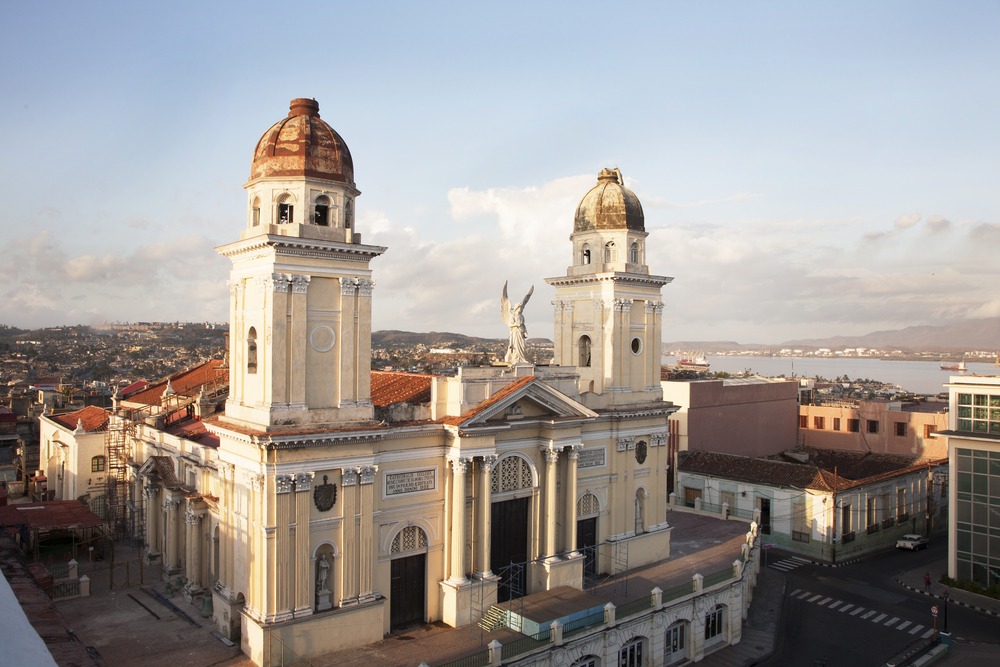
- The Santiago Cathedral, another island heritage landmark
- The Bay of Pigs, emblematic site of revolutionary history
- The Jagua Castle, near Cienfuegos
Frequently Asked Questions
Frequently asked questions
Access to the esplanade and views of the monumental Che and Camilo portraits are free. Only the José Martí Memorial museum and access to the viewpoint atop the tower are paid.
Allow approximately 30 minutes to walk the plaza and photograph the facades, plus an additional hour if visiting the museum and ascending the José Martí Memorial viewpoint.
Yes. A 90-meter elevator and staircase of 579 steps lead to a viewpoint at 129 meters, offering panoramic views over Havana.
Morning, when light highlights the tower's pale marble and heat remains moderate. Late afternoon is also worthwhile for photographing the illuminated portraits at dusk.
Developed under Batista in the 1950s as Plaza Cívica, it was renamed Plaza de la Revolución by Fidel Castro in 1959 following the regime's overthrow, becoming the country's primary site for political gatherings.
Include Plaza de la Revolución in Your Trip
Plaza de la Revolución is almost always visited as part of a stay combining Havana, Viñales, Trinidad, or Santiago. To build an itinerary blending revolutionary history, colonial heritage, and Caribbean beaches, explore our Cuba travel ideas.
Nearby
Interested in this visit?
We can include it in your personalised itinerary.