Fusterlandia
Fusterlandia
Just 15 km from Havana, the Jaimanitas neighborhood has been transformed by the imagination of José Fuster. Giant mosaics, popular art, and community engagement: your complete guide to Fusterlandia.
About fifteen kilometers from downtown Havana, the Jaimanitas neighborhood is unlike any other place on earth. Once a modest fishing village, it has been entirely transformed by the imagination of José Fuster, one of Cuba's most emblematic artists. Here, he created Fusterlandia, a universe bursting with color where every wall becomes a canvas, every façade a masterpiece, and every corner a celebration of creativity. Nicknamed the "Gaudi of the Caribbean," Fuster has turned his neighborhood into an enchanted realm of popular art, towering mosaics, and visual poetry that captivates all who venture into its streets.
José Fuster, an artist with a colorful dream
Born in 1946 in Villa Clara, José Antonio Rodriguez Fuster moved to Havana to study fine arts at the National School of Instructors. He developed a passion early on for painting, ceramics, and sculpture, disciplines he refined over the years. Exhibited internationally, his travels exposed him to European masters like Picasso, Brâncusi, and especially Gaudí, whose modernist aesthetic inspired him to imagine a popular and immersive artistic project for his own country.
In 1975, Fuster moved into a modest wooden house in Jaimanitas, a disadvantaged fishing village west of Havana. He then decided to pursue his dream: transform his living space into a total artistic environment. He began covering his house with marine creatures, human figures, mermaids, roosters, and Caribbean symbols. Quickly, his house became a veritable artistic labyrinth, from its foundations to its roof, including the swimming pool.
Fusterlandia, a neighborhood turned into a work of art
What began as a simple decorated house soon became a collective movement. Fuster invited his neighbors to participate, and more than 80 houses agreed to become part of his artistic vision. The entire neighborhood transformed: walls, benches, rooftops, gates, and bus stops became canvases for exuberant and joyful creation.
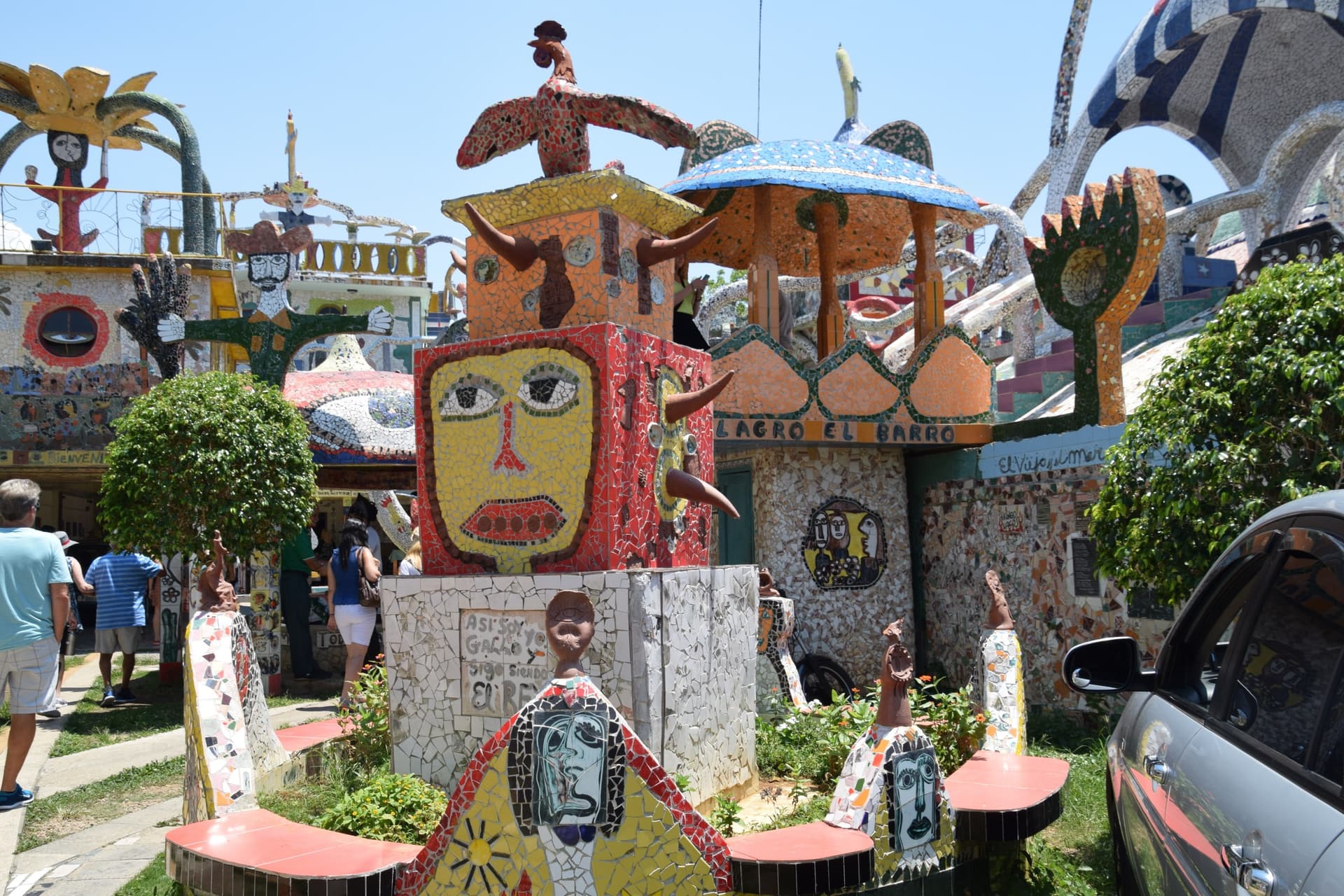
Named Fusterlandia, this artistic village draws inspiration from both Cuban culture and Fuster's imagination. Palm trees, fish, domino scenes, Santería symbols, and messages of peace such as "Viva Cuba" and "No Guerra" adorn its streets.
A community-driven and committed approach
Fusterlandia is not simply an explosion of color or an open-air masterpiece—it is above all a collective work born from one man's dream and nourished by a neighborhood's solidarity. From the start, José Fuster was committed to making his art an engaged project, inviting Jaimanitas residents to participate in transforming their surroundings. He did not simply decorate his own house: he restored residences, beautified schools, adorned bus stops and medical centers with vibrant murals, restoring soul to this modest fishing village.
With the support of his neighbors and thanks to income from selling his works, the artist has financed social and cultural initiatives, providing employment to those hit hard by the economic crisis of the 1990s. Gradually, more than 80 houses and buildings were "fusterized" in a unique community spirit. The project, dubbed "The Joy of Living," came to life on every street corner.
Over the years, Fusterlandia became a symbol of participatory popular art, where every detail—an archway, a façade, a quotation—bears the mark of a collective dream. The project shows no signs of slowing down. Even today, Fuster works in his studio while imagining the future of this whimsical world he hopes will endure after him. A new generation of local artists is flourishing under his influence, and Jaimanitas, now a major center of Cuban creativity, welcomes visitors from around the world who come to discover this utopia where art becomes an engine of social transformation.
Why visit Fusterlandia?
As you stroll through the streets of Fusterlandia, each step immerses you in a vibrant world where Cuban popular art expresses itself with boldness and poetry. This neighborhood reinvented by José Fuster offers a total immersion into a magical realist universe, blending rural heritage, Caribbean colors, and the sea, in décor inspired by Gaudí, Picasso, and local traditions. What was once a modest area on Havana's periphery is now an open-air gallery spanning three levels, attracting visitors from far and wide.
You'll discover an abundance of mosaics, sculptures, and murals depicting fishermen, American cars, and revolutionary figures like the Granma boat. Messages of peace, love, and hope sit alongside colorful motifs, infusing new energy into what was once a gray neighborhood. Climbing the stairs of Casa de Fuster leads to a balcony decorated with tiles, offering a panoramic view of this artistic jungle.
The place also invites encounters: residents proud of their neighborhood, local artists, and even Fuster himself, still present in his studio, welcome visitors warmly. You'll also find:
- A few modest cafés and artisanal craft shops with colorful façades
- Private houses decorated in the same exuberant style
- Photogenic corners around every turn
Visiting Fusterlandia is experiencing something simultaneously visual, human, and cultural—far from typical tourist clichés, at the heart of an artistic project that has become a model of social transformation.
Although Fusterlandia is technically part of Havana, this area remains outside classic tourist circuits, making it an original and colorful escape.
To reach this genuine open-air museum, several options are available:
- A taxi remains the fastest and most comfortable option. Expect about 25 to 30 minutes from Habana Vieja. It's recommended to reserve a taxi by the hour to avoid difficulties finding one on-site and to potentially make other stops along the way.
- Hop-on, hop-off tourist buses (such as those departing from Parque Central) can drop you at La Cecilia, their last stop before turning back. From there, a short taxi ride will take you to Jaimanitas.
- Local bus lines such as P-1, P-10, T-1, or T-2 also serve the neighborhood, though the journey can be lengthy and sometimes complicated. Be sure to tell the driver your destination: "Casa de Fuster."
- Guided tours, such as "Havana's Contrasts" tours, typically include a stop at Fusterlandia while exploring other lesser-known neighborhoods.
Practical information
Entry to Fusterlandia is completely free, whether strolling through the neighborhood's colorful streets or visiting José Fuster's studio. However, a small donation box sits at the entrance: voluntary contributions help support site maintenance and fund future artistic projects. Fusterlandia is generally open daily from 9 a.m. to 5 p.m. Note that the gallery may occasionally close for private events.
Also, while certain areas of the site are not open to the public, you can freely explore the main sections, take photos, and discover the artist's creations. To fully enjoy the experience and chat with residents in a peaceful atmosphere, it's best to arrive early in the morning.
Finally, original works by José Fuster are available for purchase in the ground-floor gallery as well as in the shop on the upper level, located just across from the main building. You'll find both large pieces and affordable souvenirs. Several neighbors have also begun selling handmade creations, transforming the neighborhood into a vibrant little market during opening hours.
Want to discover this destination?
Our local advisors design your tailor-made trip.